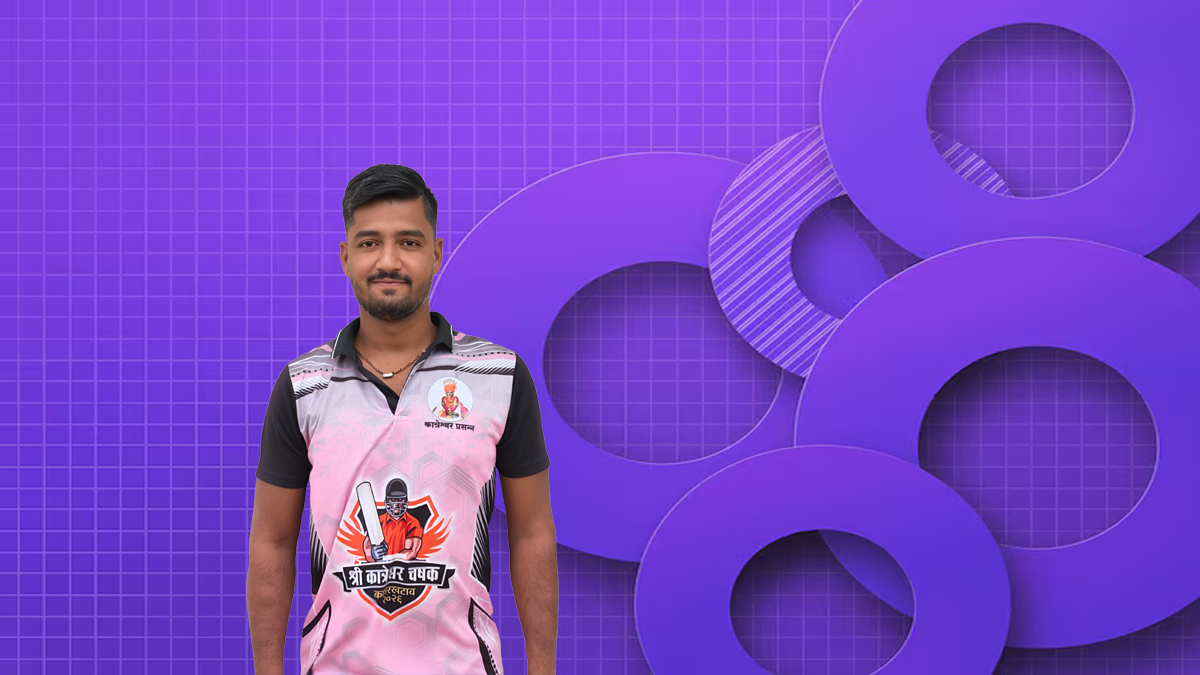
In Satara’s drought-hardened fields, a milkman’s son taught himself the rhythm of a cricketer — one tied ball, one stolen hour, one unshakeable belief at a time.
Some athletes are made in academies, under the watchful eyes of coaches who chart every net session on a clipboard. Sudhakar Baburao Kharmate was made somewhere else entirely — in the red dust of Enkul, a village tucked into Khatav taluka, where the only certainty each morning was work, and cricket had to fight for whatever hours remained.
He cannot tell you the first time he picked up a bat. There was no single, cinematic beginning — only a slow, steady accumulation of afternoons, a ball worn smooth by hands that had spent the morning elsewhere. After finishing his twelfth standard in Science at Maharshi Shinde Vidyalaya, Sudhakar entered the family milk business, the only trade he’d ever really known. He remains, to this day, the sole sportsperson in his household — an anomaly explained by nothing more mystical than a boy, a ball, and a ground he couldn’t stay away from.
Four o’clock became a kind of religion. Mornings belonged to labour, non-negotiable in a region where drought makes every task urgent. But once the day’s obligations were met, Sudhakar would head home, change, and walk to the ground as the light began to soften. Neighbours asked, not unkindly, whether cricket would ever put food on the table. He never had a clever rebuttal. He simply kept showing up.
Two names shaped those early years: Malhari Khade and Deva Khade — the latter known to everyone, with the easy affection of small towns, as Aba. Their coaching philosophy was almost defiantly simple. Practise. Every day. That’s it. For a boy without access to turf wickets or bowling machines, that discipline became the only infrastructure he needed.
The Phone Call That Found Him in a Field
It’s a detail almost too poetic to be true, except that it is: the call that changed everything reached Sudhakar while he was still working the land. Malhari Khade, his mentor, asked if he’d be interested in playing the Maharashtra Professional Cricket League — in Mumbai, no less, a city that exists in the imagination of small-town cricketers the way Paris exists in the imagination of small-town seamstresses.
He said yes before he’d finished hearing the question. He put down whatever he was carrying and filled out the form on the spot. There was no grand celebration, no fireworks — just the quiet, disorienting sense that a door he’d been leaning against for years had finally swung open. He told his family first. He says the joy was almost impossible to hold.
Building a Nets Session Out of Nothing
Selection, of course, is only an invitation — the real work started after. Sudhakar’s training intensified: more time on the ground, more hours in whatever nets he could find, and at home, a method as resourceful as it is humble — a cricket ball tied to a tree, swung and struck in isolation, again and again, until the motion became instinct rather than thought.
These days, he’ll happily spend four hours at a stretch in the nets. Batting, for him, isn’t one skill among several — it’s the entire architecture of his game, built on a confidence he describes as his greatest asset, earned the only way confidence is ever really earned: one repetition at a time.
A Little of Rohit Sharma, A Lot of His Own Stillness
Ask him who he studies, and he doesn’t reach for the flashiest name in the room. He talks about Rohit Sharma’s calm — the unhurried patience that lets a great batsman absorb pressure without ever looking rattled. It’s a quality Sudhakar is still chasing in his own game, aware that temperament, not just technique, is what separates a good innings from a forgettable one.
What the Village Gave Him
There is no version of this story without hardship. Money was scarce. Time was scarcer. Professional coaching, for most of his life, was a luxury that belonged to other people’s biographies. But scarcity taught Sudhakar something coaching manuals rarely do: how to return. To the ground, to the tree with the ball tied to it, to the belief that the next season might be the one that changes everything.
That refusal to quit — quiet, unglamorous, entirely his own — is the closest thing he has to a signature.
The IPL, Spoken Like a Certainty
Now his sights are set higher: the Indian Premier League, spoken of not as a distant fantasy but as something almost already claimed.
“Personally, I feel as if I have already been selected for the IPL,” he says — not with arrogance, but with the calm conviction of someone who has decided, long ago, what kind of story this is going to be.
His philosophy fits in a single line: success, and only success. He knows the scepticism that follows a boy from a village few people can locate on a map. He doesn’t argue with it. He simply keeps batting — his answer to doubt has never been a speech, only a scorecard waiting to be written.
The Boy Who Won’t Stay Out
There’s a detail about Sudhakar that tends to draw a smile from anyone who’s watched him play: even when he’s dismissed, he can’t quite accept the innings is over. His first instinct is always to pick the bat back up — one more ball, one more chance, one more try.
It sounds like a small, almost comic habit. But it is, in truth, the whole of his story in miniature.
From the dust of Enkul to the sharper, faster world of the MPCL, Sudhakar Kharmate has travelled further than the map would suggest — and he has done it without losing the hunger that started it all.
The IPL is still, for now, a dream.
But he is holding the bat. And he is still walking toward the lights.