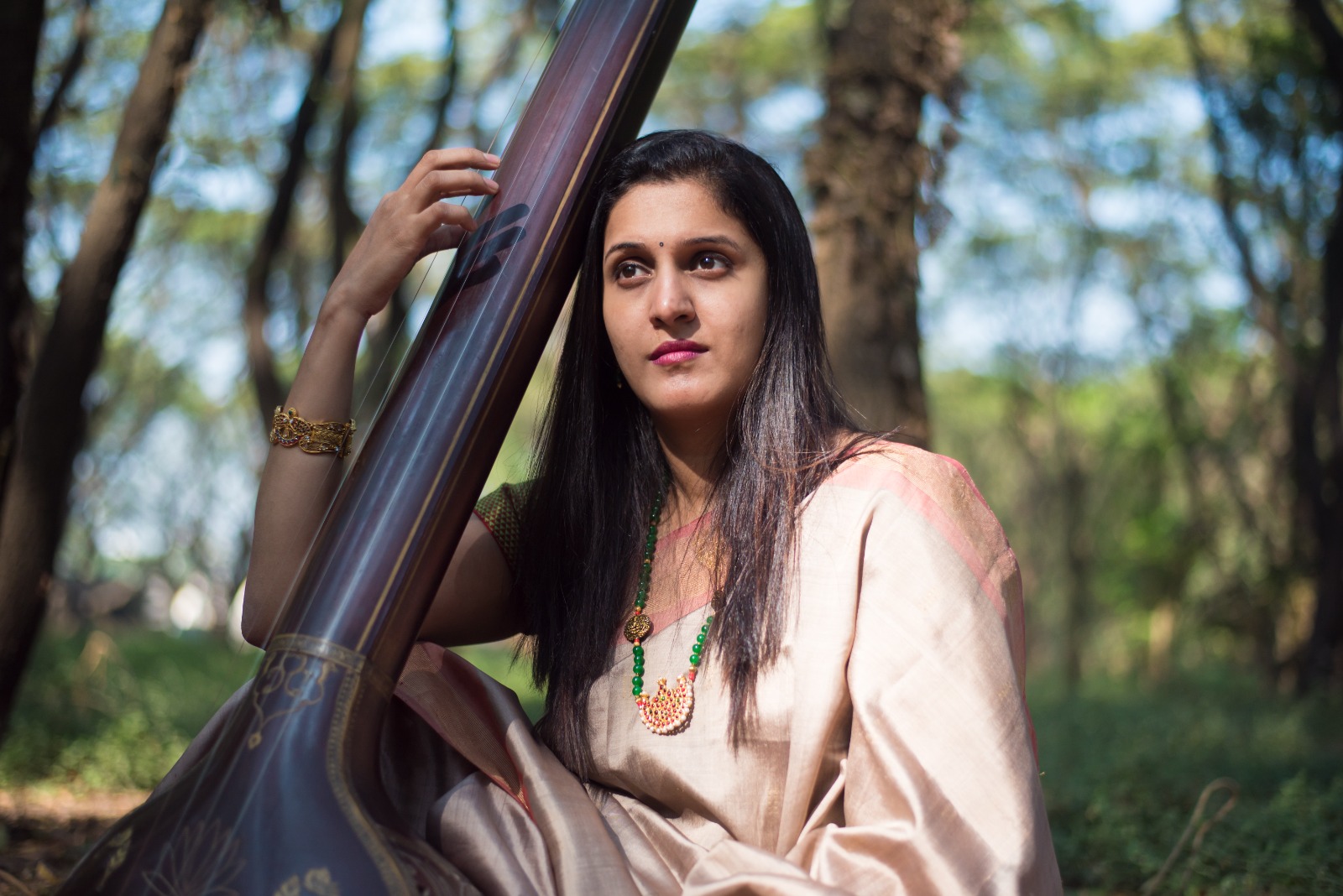
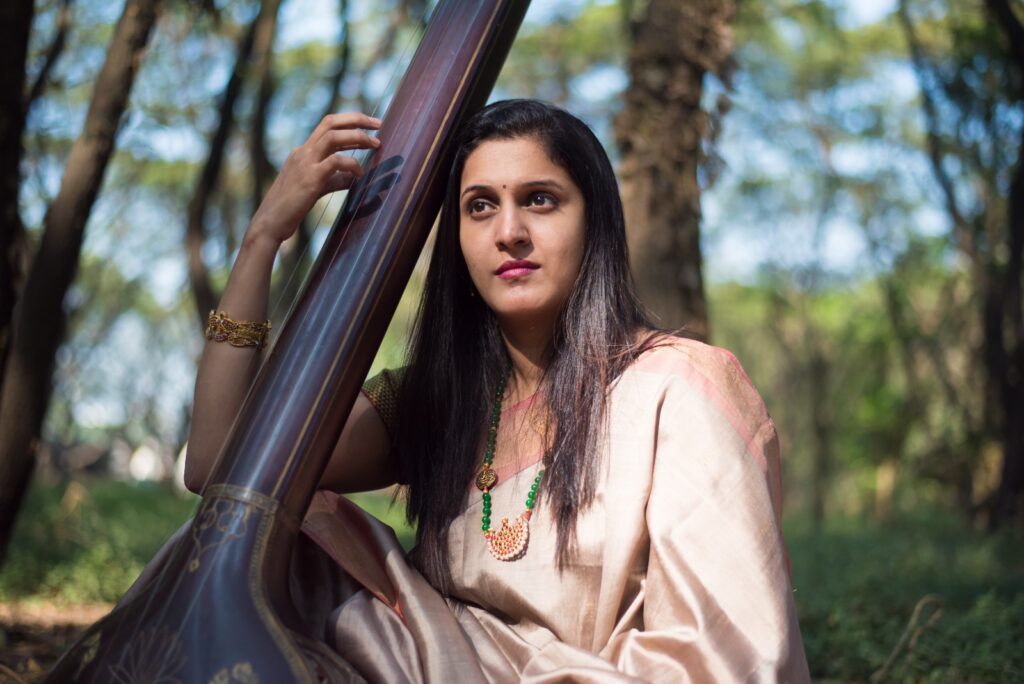
There are artists who preserve tradition, and there are artists who transform it into something that breathes effortlessly in the present moment. Ashwini Paranjape Ranade belongs to the rare intersection of both worlds—a vocalist whose musical language carries the discipline of Hindustani classical music while embracing the emotional openness of contemporary independent artistry.
Elegant yet grounded, deeply trained yet emotionally accessible, Ashwini’s journey unfolds like one of the ragas she grew up with: patient, layered, and resonant long after the final note fades.
Born into the rich musical culture of Mumbai, Ashwini was raised in an environment where music and spirituality were deeply intertwined. She comes from a family steeped in devotional and performance tradition: her maternal grandfather was a respected kirtankar, while her father continues the legacy as a practicing kirtankar who has traveled across India performing kirtans at prestigious temples and sacred sites. Surrounded by devotional music, storytelling, and classical expression from an early age, Ashwini developed a natural emotional connection to music long before formal training began.
At the age of ten, she began rigorous classical training under Pandit Manohar Joshi of the revered Gwalior Gharana. What followed was not merely education, but immersion. Over fourteen years of disciplined study, she cultivated a voice shaped by precision, lyrical depth, and emotional intelligence. Her dedication culminated in earning the prestigious Sangeet Visharad Pratham certification from the Akhil Bharatiya Gandharva Mahavidyalay Mandal in 2013.
But Ashwini’s artistry was never confined to a single form.
Alongside classical music, she explored the nuanced worlds of ghazals, bhajans, and Marathi and Hindi light music under the guidance of Shri Vikas Bhatawadekar. This expansion gave her music a rare versatility—one that allows her to move fluidly between traditional compositions and intimate contemporary storytelling.
Today, that versatility defines her artistic signature.
Whether performing a semi-classical melody, recording original music, or interpreting emotionally layered lyrics, Ashwini approaches music with restraint and refinement rather than theatrical excess. Her voice does not demand attention—it draws listeners inward.
In 2014, Ashwini moved to the United States, carrying with her not only years of classical training, but also an unwavering commitment to artistic continuity. Settling in the Boston area, she continued advanced musical study under Smt. Swati Panda at the Raganjali School of Music in Massachusetts, further deepening her connection to Hindustani classical tradition while simultaneously expanding her global artistic identity.
What emerged over the years was a compelling presence within the Indian diaspora’s cultural landscape in New England.
Through concerts, collaborations, cultural events, and independent releases, Ashwini gradually became known as a voice that preserves authenticity without resisting evolution. Her performances reflect an artist equally comfortable with tradition and experimentation—someone capable of honoring heritage while speaking to modern audiences across continents.
That balance has become increasingly visible in her growing public profile.
In March 2025, Ashwini was featured as a lead performer at the 22nd Annual Woman of the Year Awards Gala in Burlington, Massachusetts—an event attended by influential figures from business, academia, and the arts. The performance further positioned her as one of the emerging artistic voices shaping the South Asian cultural experience in the United States.
Yet perhaps the most intimate reflection of her artistry exists in her original music.
In 2017, Ashwini introduced audiences to two original albums: Mann Baware in Hindi and Kalyanche Diwas in Marathi. Both projects revealed a songwriter and vocalist deeply invested in emotional atmosphere, lyrical sensitivity, and melodic storytelling. Rather than chasing commercial formulas, the albums embraced sincerity—allowing listeners to experience music that felt personal, poetic, and rooted in feeling.
Songs from these projects found strong resonance across digital platforms, with tracks such as Shravan Masi Harsh Manasi earning significant audience engagement online and connecting with listeners far beyond geographical boundaries.
Her later releases continued this independent musical journey. With works like Kahe Karat Barjori and her evolving catalog of originals, Ashwini steadily carved out a space where classical nuance and modern accessibility coexist naturally.
That artistic evolution finds one of its most refined expressions in her latest Marathi single, Tujhya Chahulichi Dhun (2025).
Released around Valentine’s season, the song explores longing, affection, and emotional presence through lyrical imagery and delicate melodic phrasing. Rich orchestration blends seamlessly with poetic intimacy, creating a soundscape where emotion unfolds gradually rather than dramatically. The composition reflects Ashwini’s signature sensibility: music that values depth over noise, atmosphere over spectacle.
There is a cinematic softness to the track, but beneath it remains the unmistakable discipline of a classically trained artist—every note measured, every phrase intentional.
Beyond performance and recording, Ashwini’s contribution to music extends powerfully into education. Having worked as a music teacher in India and later in the Boston area, she has spent years mentoring students with a philosophy rooted equally in technical rigor and emotional understanding. Since 2020, she has actively trained vocal music students in Massachusetts, carrying forward a lineage that values not only skill, but sensitivity.
For Ashwini, teaching is not separate from performing—it is part of the same artistic continuum.
In an age where digital culture often rewards speed over substance, Ashwini Paranjape Ranade represents something increasingly rare: an artist who allows music to mature organically. Her work does not attempt to modernize classical tradition by abandoning it. Instead, she gently extends its vocabulary into contemporary spaces, making it accessible to newer generations without losing its soul.
That may ultimately define the beauty of her journey.
She is not simply revisiting tradition. She is allowing it to travel—across languages, across continents, across generations—and teaching it how to sing again in the modern world.